Q: Now that ASC Data has joined ASCA’s affinity partnership program, what does that mean for ASCA members?
CS: Our team has worked closely with ASCA over the years, and we share its mission of supporting the advancement of high-quality patient care. Being a part of ASCA’s affinity partnership program means ASCA members can now receive exclusive, discounted pricing on all of ASC Data’s products. This is particularly beneficial for industry suppliers, consultants or investors who are looking to access the critical, data-driven insights they need to identify new leads, monitor the industry and optimize their sales strategy. Our goal has always been to help our subscribers better understand the ins and outs of the ASC market, so they can better tailor their solutions to its unique needs.
Q: Looking at your current data set, what can ASCs expect to see this year?
CS: One of the things I find most helpful about our data is that it allows us to easily identify patterns and trends within the industry. Take the CMS ASC Covered Procedures List for example. Each year, CMS adds new codes to the list, but the impact of those changes is not always immediately evident. Most ASCs operate at high capacity, which can make introducing new procedures a challenge, and many do not have the OR time, equipment or credentialing to start offering them right away.
Over the past decade, though, we have seen the number of ORs per ASC increase in both single- and multispecialty facilities, which reflects a steady increase in procedure volume and complexity. More notably, we have also seen how the migration of higher-acuity procedures—like total joint replacement, spinal fusion and angioplasty—from the hospital setting has really shifted the ASC landscape.
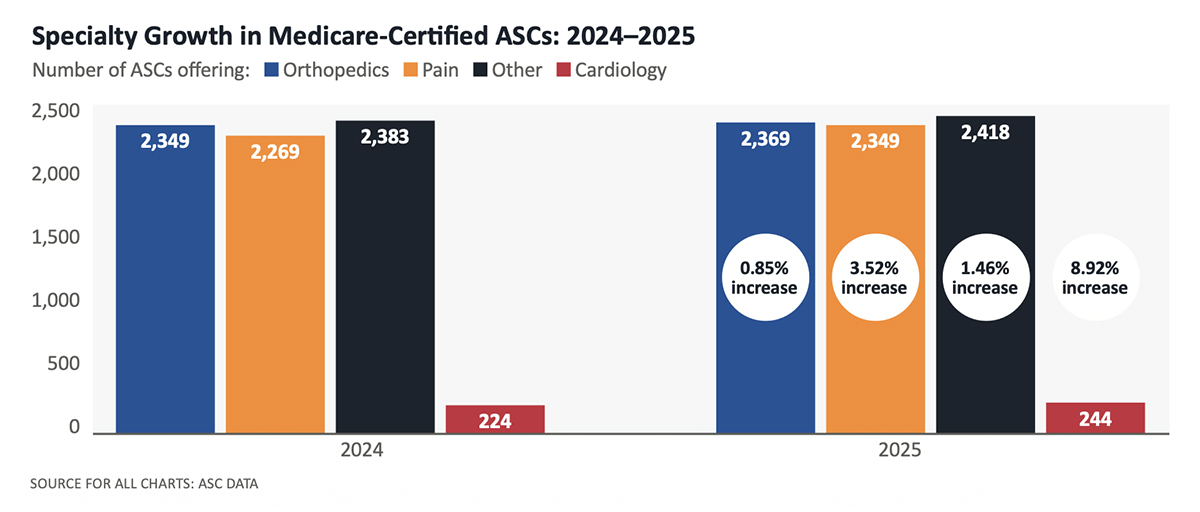
Over the past year, our data has shown growth in specialties like orthopedics, pain management and what CMS classifies as “other,” which includes specialties like neurosurgery, spine and cardiovascular. These remain the primary engines for growth and revenue across the industry. And with more than 30 new cardiovascular and vascular codes added for 2026, we expect to start seeing the rate of conversions from office-based labs to ASCs increase significantly.