Orthopedics, gastroenterology, ophthalmology and general surgery remain the foundation of ASC growth, said Josh Aaker, associate principal of Vizient strategy intelligence. “Cardiovascular procedures are emerging as one of the next significant opportunities as the Centers for Medicare & Medicaid Services expands ambulatory eligibility for select interventions,” he said. “Physicians have greater confidence performing these procedures in ASCs and, in many cases, equity ownership further aligns physicians with the ambulatory setting. Payers recognize these procedures can be delivered safely and efficiently at a lower cost, while patients increasingly value the convenience and experience. These forces combine to expand the range of procedures moving into ambulatory settings.”
However, the growth will vary considerably by market and by procedure, said Donnelle Jageman, senior director of Vizient strategy intelligence. “Physician alignment, payer dynamics, state regulations, competitive intensity and local demographics all influence the pace of ambulatory migration,” she said. “Some markets have already shifted a substantial share of procedures into ASCs, while others have significant runway ahead.
“National trends establish direction, but local dynamics and strategy determine how quickly organizations may capture growth and how quickly markets will shift,” Jageman said.
While the long-term trend is similar, several policy changes are accelerating ambulatory migration this year, Kopaskie said. “This year’s forecast incorporates the phased elimination of the inpatient-only list, expansion of the ASC Covered Procedures List and continued movement toward site-neutral payment. Combined with evolving state regulations and advancing technology, those changes support continued growth for ASCs over the next decade.”
Consolidation will influence the ASC sector’s growth. “Consolidation will continue as health systems, national ASC operators and physician groups invest in scale and market reach,” Aaker said. “The Ascension-Amsurg deal is a strong example of this trend. ASCs have become a strategic platform for growth, enabling organizations to expand access, strengthen physician partnerships and deliver more affordable surgical care. As ambulatory demand continues to grow, scale will increasingly create advantages in operations, contracting and physician alignment.”
Continue Reading Below
To best leverage this growth trend, ASCs will need the discipline to evolve alongside the market, Jageman said. “A diverse case mix with careful patient and procedure selection, strong physician alignment that keeps operating rooms fully utilized, operational efficiency, and flexible facilities designed to accommodate increasingly complex procedures will position organizations to capture future ASC growth.”
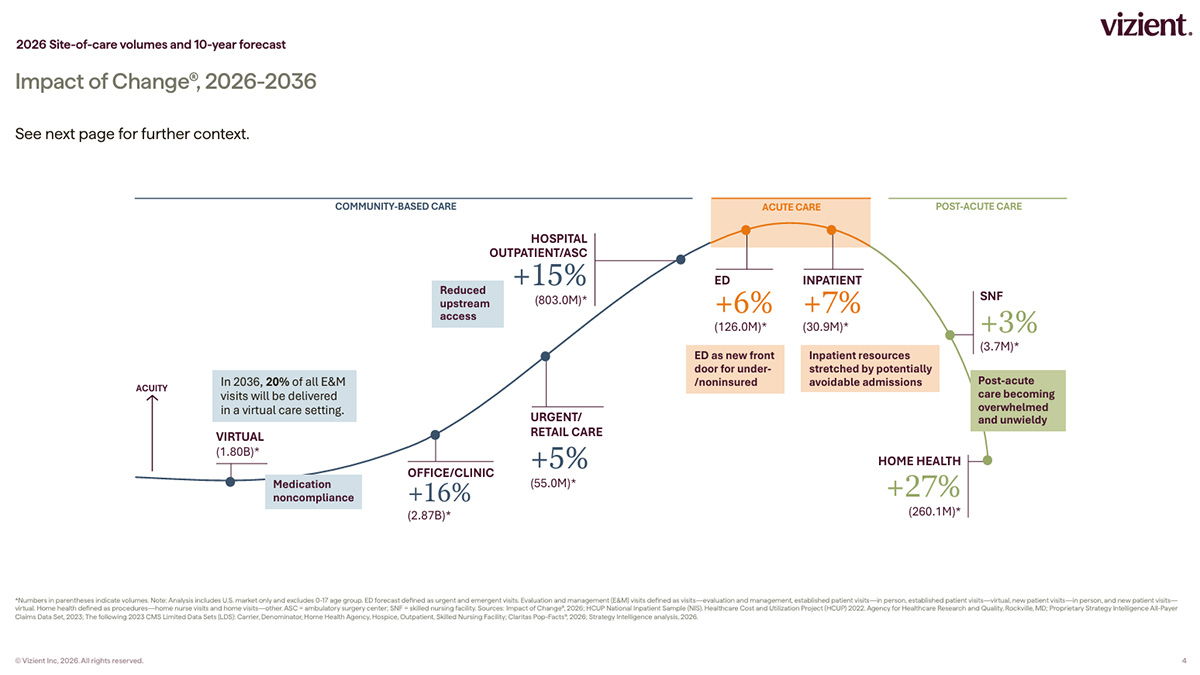
Hospital outpatient departments will remain the largest procedural setting and are projected to grow 14% over the next decade, driven by an aging population that continues to require more complex ambulatory care, Kopaskie said. “As procedures migrate to ASCs, HOPDs will increasingly focus on higher-acuity outpatient surgery, advanced diagnostics and multidisciplinary care. The phased elimination of the inpatient-only list will also accelerate the shift of appropriate low-LOS [length of stay] cases from inpatient to outpatient status, reinforcing the HOPD’s role in managing more clinically complex patients.”
Patient expectations are evolving quickly, Kopaskie said. “Convenience, access and experience increasingly influence where patients choose to receive care. For elective surgery, however, physician choice is a powerful influence. Patients often follow their surgeon, making physician alignment a critical driver of migration into ASCs.”
ASCA Board President Todd Currier said, “Vizient’s forecast confirms that ASCs are not just part of healthcare’s future — they are helping define it. Patients increasingly prefer the convenience and experience ASCs provide; physicians recognize their efficiency and clinical quality; and payers value the lower-cost setting. Surgery centers are well positioned to absorb this growing demand while maintaining exceptional patient outcomes. To fully realize that potential, however, Medicare and commercial payers must support policies and reimbursement structures that reflect the tremendous value ASCs deliver every day.”
Other trends
The forecast highlights several trends affecting healthcare delivery and its service lines, including:
- Post-acute care: Volumes are expected to increase by 31% as more recovery, rehabilitation and chronic care migrate to lower-cost settings, with home health expected to increase 13% over the next five years.
- Pediatric care: Continued declines in birth rates are reshaping demand, with outpatient volumes growing 6%, while inpatient utilization remains constrained.
- Cancer care: Outpatient volumes will grow 20%, while inpatient demand remains flat as diagnostics, treatment and follow-up care shift to ambulatory settings.
- Virtual care: One in five evaluation and management visits will occur remotely by 2036, reflecting the continuation of digital care models across the healthcare system.
- Behavioral health: Rising prevalence and acuity continue to drive demand, while care increasingly expands into community-based and virtual settings.
- Orthopedics: Physician alignment and policy pressures are accelerating the shift to ambulatory, rehabilitation and lower-resource care settings.
- Women’s health: Strong growth in the 65-plus population supports a growing need for pelvic health and menopause services.
Read more about the 2026 Impact of Change forecast.